
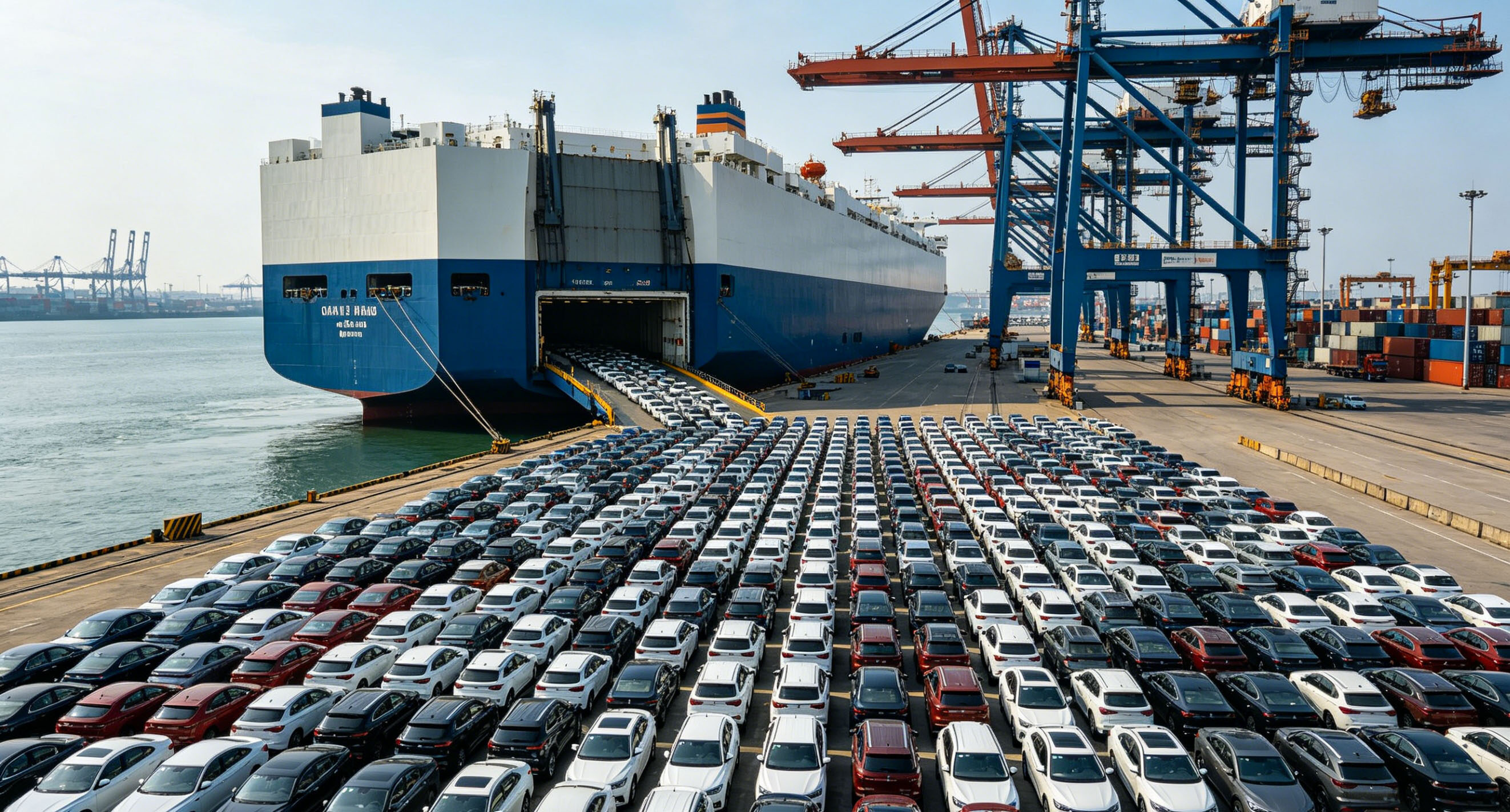
Mofan Auto ReportIn Q1 of 2026, China's used car exports achieved a strong start with increased volume, stable prices, and improved structure, driven by the implementation of new compliance regulations in **, robust overseas demand, and the release of trade benefits **. Key export markets include Russia, Africa, and Central Asia. Used vehicles aged ** to 5 years are now the absolute core of exports **. Meanwhile, exports of new energy used cars led growth across all categories, marking the industry's transition from an era of arbitrage based on "zero-mileage" pseudo-used cars to a new phase of standardized, high-quality global expansion.
1. Core Data: Export volumes and prices both rise; all ports show gains
In the first quarter of 2026, China's used car exports continued their high-growth trajectory, driven by explosive growth in the ** Russian market, the release of zero-tariff benefits in Africa, and improved customs clearance efficiency at land ports.
- Russian MarketIn Q1, used car imports from China reached **1.94 units (**), surging **145% (a 2.5-fold increase) ** year over year, making China the largest overseas market for used cars. The top five brands were Volkswagen, Audi, Toyota, Honda, and BMW, with best-selling models including the Corolla, VW Tayron, and Audi Q3.
- Northern Land PortsIn the first quarter, Manzhouli Highway Port exported **1178 units of **, a year-on-year increase of **74.78%**, with trade value reaching 1.4 billion yuan. Ports such as Suifenhe and Khorgos also saw significant growth, establishing land routes as the core engine for exports to Russia and Central Asia.
- African Market: Benefiting from the early impact of the two-year zero-tariff policy on all product categories for 53 in Africa starting in 5, first-quarter exports doubled year-over-year by ** (**), with strong demand for budget-friendly fuel vehicles and entry-level EVs. The Guiyang export base shipped over 350 units in Q1, generating revenue exceeding 3000 yuan.
- New Energy Used Cars: First-quarter exports grew **67% year over year, with **75% heading to Southeast Asia and Africa**, highlighting the advantage of high cost-performance.
II. Policy-Driven: Implementation of the 180-Day Red Line Ends Fake Used Car Exports
Effective from 2026/1/1, the new joint policy issued by the Ministry of Commerce and three other departments has been fully implemented. Key provision ** — "export of vehicles registered for fewer than 180 days requires a manufacturer after-sales confirmation letter" ** — is now strictly enforced, completely closing the 0-kilometer loophole in fake used car exports **.
- Raising compliance thresholdsThe new policy targets gray-market schemes of exploiting tax refunds on new cars. Used vehicles aged **-3 years with 3-5 thousand miles become the main export drivers.
- Industry consolidation acceleratesSmall and medium speculators are forced to exit the market due to their inability to obtain OEM confirmation letters. Leading compliant companies, leveraging their qualifications, vehicle refurbishment capabilities, and overseas after-sales networks, are capturing market share as the export structure shifts toward high-quality standards.
- Supported by national unified standards: Implement unified used car transaction standards for synchronized deployment (one-vehicle-one-code traceability, mandatory inspections, and escrow services) to further enhance export vehicle transparency and reduce trust costs in overseas markets.
3. Market Structure: Dual Optimization of Vehicle Models and Markets, with High Cost-Performance Becoming the Core Competitiveness
1. Vehicle Types: Fuel vehicles remain the core, while new energy vehicles see strong growth.
- Gasoline vehicle: 1.6L–2.0L economy sedans (Corolla, Lavida) and pickups (Great Wall Wingle) are essential for Africa and Central Asia. ** offers significantly better value than local new vehicles at **.
- New Energy VehicleEntry-level EVs from BYD, Wuling, and others are rapidly penetrating Southeast Asia and Africa due to their low operating costs. Export of used EVs requires mandatory upload of battery SOH; exports are prohibited if ** battery health is below 70% to protect overseas consumers' rights.
2. Market: Dual core of Russia and Africa, multi-region expansion in sync
- RussiaHigh energy prices and insufficient domestic production in Europe have enabled Chinese used cars to rapidly capture the market with a ** price advantage and strong compatibility with European/Japanese brands (**). In the first quarter, they accounted for over 40% of China's total used car exports.
- AfricaAfter the zero-tariff policy took effect, the total cost of used cars dropped by 15%–20%, making China the fastest-growing market for used car volume **. The annual volume is expected to exceed 10 vehicles.
- Central Asia / Southeast AsiaCountries along the Belt and Road Initiative offer tariff reductions and stable demand, making them an important supplementary market for used vehicle exports.
IV. Industry Outlook: Compliance Reshapes the Landscape, Unlocking a Trillion-Dollar Global Expansion
China's vehicle stock exceeds **3.5 billion units**. With over 10 million used vehicles entering circulation annually, used car exports have become a core channel for clearing domestic inventory and enhancing industry value.
Industry experts say 2026 will be the first year of standardized used-car exports in China**: short-term compliance-driven consolidation will accelerate, while long-term competitiveness will hinge on vehicle condition transparency and international after-sales services. With policies such as zero tariffs between China and Africa and trade facilitation under the Shanghai Cooperation Organization taking effect, combined with surging global demand for new-energy used vehicles, total used-car exports in **2026 are expected to exceed 60 units**, maintaining China's position as the world's largest used-car exporter.